Opening Session: Foundations and Field Evidence

The Case for Beauty in the Built Environment: Why Humanitarian Aid without Aesthetics Fails

  • beauty in the built environment
  • beautification
  • displacement
  • third-realm beauty
  • humanitarian response
  • neuroaesthetics
  • hope
  • healing
  • dignity
  • agency
  • cultural identity
  • Afghanistan
  • community resilience
  • postmemory
  • UN-Habitat
  • participatory design
  • climate-sensitive design
  • rights-based frameworks

Speakers:

Dr. Devora Neumark is an interdisciplinary artist-researcher and co-founder of Home Ground Lab. With over 30 years of leadership in academia, policy, and creative practice, they advance beauty as essential infrastructure in displacement contexts, combining participatory art, contemplative practice, and policy to promote climate justice, community resilience, dignity, and social innovation.

Stephanie Acker, co-founder of Home Ground Lab, is a policy and communications practitioner whose work has centred on ‘home’ and has held roles with the U.S. Office of Refugee Resettlement, UNICEF, and the European University Institute. She has a master’s in public administration from Harvard Kennedy School of Government.

Stephanie Loose is the Country Programme Manager/Head of Office for UN-Habitat Afghanistan since October 2024. With over 25 years of professional experience in different countries, including in urban crisis and development settings, she strongly advocates for a humanitarian-development nexus. UN-Habitat has been implementing projects in Afghanistan for more than 30 years, applying people-centred, community-driven and area-based approaches.

Respondent:

Professor Cathrine Brun is Deputy Director at the Centre for Lebanese Studies (CLS), an independent research institute located between Beirut, Lebanon and Cambridge, UK. A human geographer, her research interests concern the ethics, politics and philosophy of humanitarianism through the lens of forced migration and conflict, young people, education, housing and home.

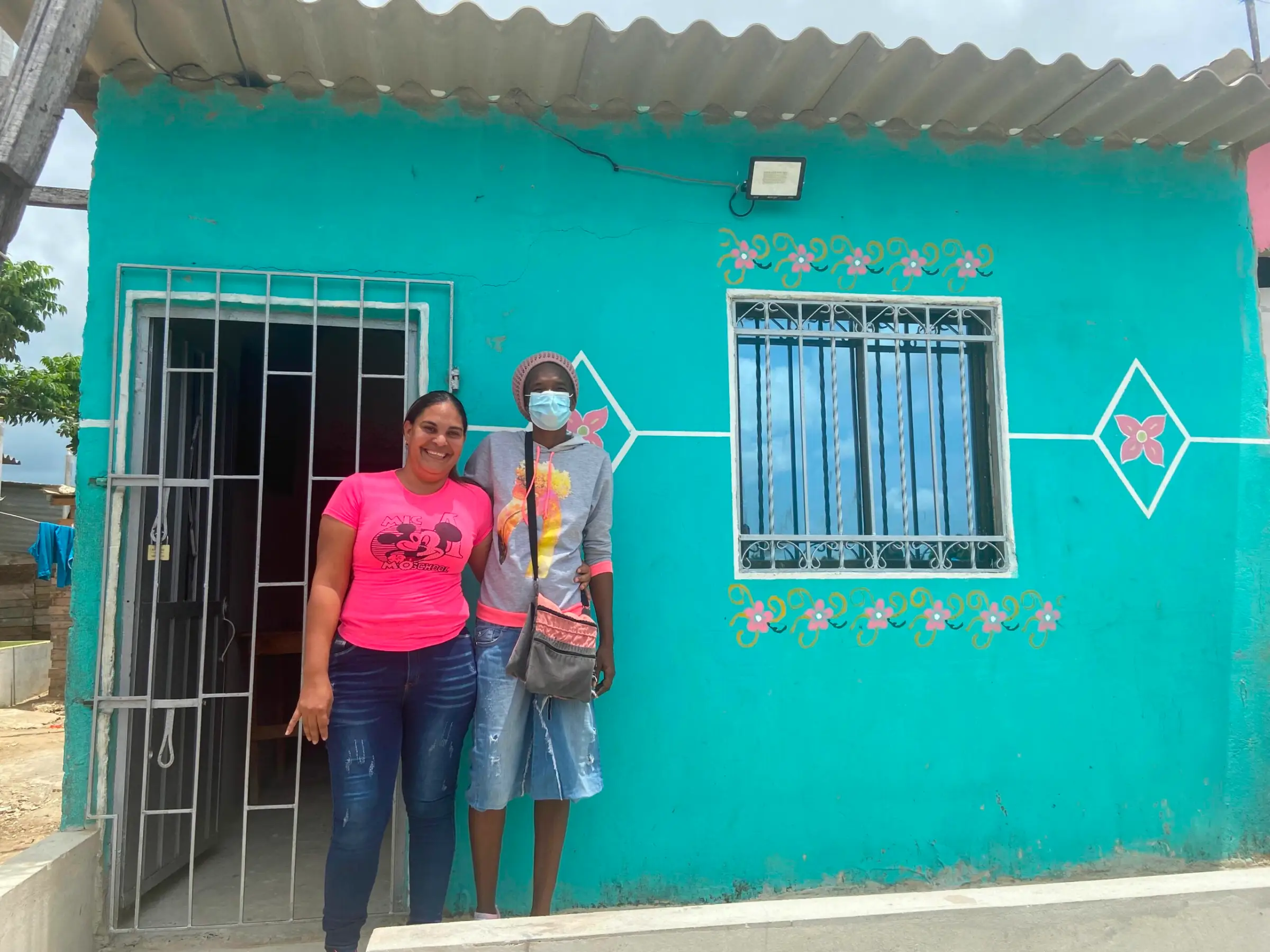
Casa Pintada participants / community members in front of repainted home-fronts with floral prints. Colombia.

Photo: Blumont Group, 2022

Summary

The opening session of the three-part webinar series Beauty, Art, Belonging and the Neuroscience of Place, co-hosted by Home Ground Lab and Clark University’s Integration and Belonging Hub on October 8, 2025, made the case that humanitarian aid without aesthetics fails. Dr. Neumark and Stephanie Acker presented their framework for beauty as survival infrastructure across three dimensions: fostering healing and hope, restoring dignity and agency, and building belonging and resilience, drawing on case studies from Palestinian refugee camps in the West Bank, owner-driven reconstruction in flood-affected Sindh, Pakistan, and the Casa Pintada initiative in Colombia. The presentation directly addressed three common objections: that beauty is a luxury reserved for later stages of response, that it is a band-aid that distracts from necessary policy change, and that if refugees are already creating beauty, humanitarian organisations have no role to play. Stephanie Loose, Country Programme Manager for UN-Habitat Afghanistan, grounded the argument in field practice, demonstrating how participatory, climate-sensitive, and multi-sectoral approaches transform temporary shelters into meaningful living environments, and closing with the observation that she herself tends a small garden outside her own container home in Afghanistan. Professor Cathrine Brun offered a critical response, asking what beauty is, whose beauty is being centred, and whether beauty is best understood as an approach or as the outcome of a broader rights-based effort to address structural inequalities in displacement. The session concluded with a generative exchange among all three speakers on the relationship between beauty, power, and the structural conditions of displacement.

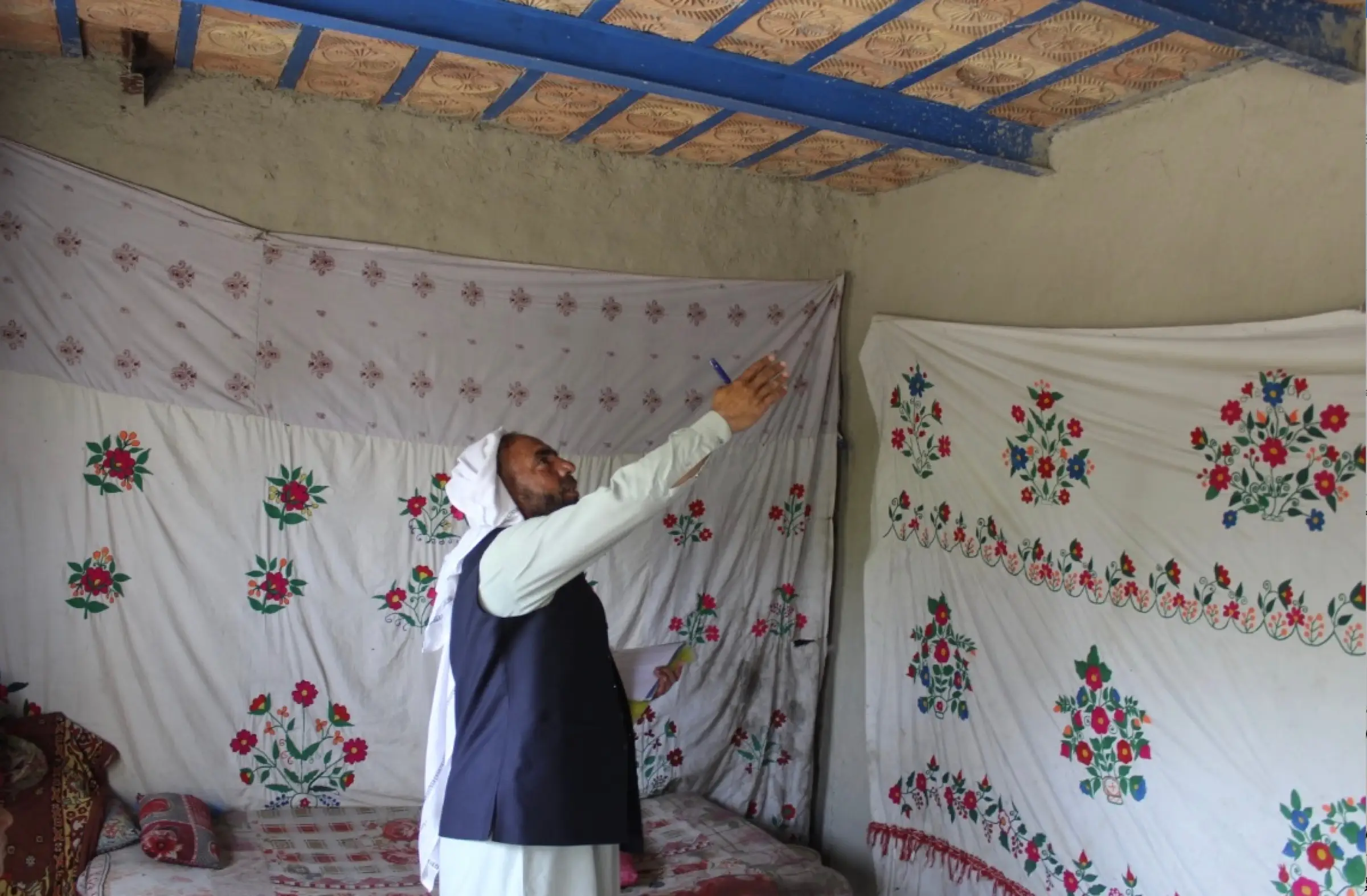
Displaced communities decorated their repaired shelters with cultural and familiar
materials and designs. Interior of a decorated shelter. Nangarhar Province, Afghanistan.

Photo: UN-Habitat Afghanistan, 2025

Key Takeaways

Dr. Devora Neumark and Stephanie Acker

  • Humanitarian aid that addresses only physical survival, food, water, and shelter, without integrating aesthetics, keeps people alive but undermines both recovery and resilience. This is not a moral argument alone but a practical one: beauty in the built environment regulates anxiety, supports present-moment awareness, and creates the neurological and psychosocial conditions necessary for hope. As Stephanie Acker summarised, food, water, and shelter keep the body alive, but beauty keeps the person alive.
  • Beauty need not wait until later stages of humanitarian response and is not a band-aid that avoids the harder work of policy change. Research and field evidence demonstrate that aesthetic qualities such as colour, light, and familiar spatial patterns have immediate stress-reducing effects from the earliest phases of crisis response, and that the quality of surroundings shapes long-term healing trajectories. Postponing beauty until later stages means missing vital windows for recovery during the acute crisis phase.
  • The creativity and beauty-making already happening in displaced communities is itself the evidence of what works. The humanitarian sector’s role is therefore not to introduce beauty as a new intervention but to study what communities are already doing, invest in and amplify those efforts, and stop actively obstructing them through restrictive policies. Stephanie Acker closed the session by inviting participants to reorient their starting point entirely: not from “what is the problem” but from “where is there beauty and where do people see beauty,” a shift from deficit to presence, and from problem to possibility.

Stephanie Loose, UN-Habitat Afghanistan

  • The argument that beauty belongs only in later stages of humanitarian response rests on a false premise: that temporary displacement is genuinely temporary. As Stephanie Loose made clear from her field experience in Afghanistan, where climate change is driving rural-urban displacement into cities already under severe strain, including Kabul facing complete groundwater depletion by 2030, durable solutions will never reach the vast majority of displaced people, and the humanitarian system does not have the resources to provide them. What it can do is create enabling environments, progressively improving what communities have already built for themselves, fitting a proper window to a house someone has already constructed, reinforcing a roof, supporting housing, land, and property rights so that residents feel secure enough to invest in their own spaces. This reframes the entire conversation: beauty is not a later-stage luxury but an immediate and incremental responsibility.
  • Small, thoughtful design decisions in humanitarian response have measurable effects on social cohesion, gender inclusion, and community resilience, as demonstrated by UN-Habitat’s public space transformation in Afghanistan. With modest investment, a neglected and unusable public space was redesigned to include flood resilience infrastructure, green elements, and a gender-sensitive corner where women, who are banned from most public spaces under the Taliban, could gather safely. Critically, the project was designed not just for displaced residents but for the entire neighbourhood, reflecting UN-Habitat’s area-based approach: that responses should never be designed exclusively for refugees or IDPs when they live in communities where host residents share the same level of vulnerability. The beauty of the design was not incidental to its function but inseparable from it: the space worked precisely because it was inviting, safe, and meaningful to everyone who used it.
  • Listening to communities before designing for them is not a procedural nicety but the foundation of dignified and effective humanitarian response. UN-Habitat’s approach in Afghanistan begins with detailed individual shelter assessments rather than standardised solutions, precisely because a window that does not fit the house it was made for fails both functionally and aesthetically. Stephanie Loose observed that even the choice to use locally sourced stones and traditional wood beam construction methods in earthquake reconstruction is itself an act of beauty, one that preserves cultural continuity while building structural resilience, and that her own team of architects and urban planners found ways to integrate beauty into every intervention, from school gardens that provided shaded gathering spaces for girls banned from formal education to water infrastructure redesigned as community gathering places. Beauty, in this framing, is not added to good design; it emerges from it.

Professor Cathrine Brun, Centre for Lebanese Studies

  • Professor Cathrine Brun’s critical response introduced a productive and unresolved tension at the heart of the field: is beauty best understood as an approach in its own right, or as the outcome of a broader rights-based effort to address structural inequalities in displacement? Stephanie Acker’s response grounded HGL’s position in Arthur Danto’s concept of third-realm beauty and in the lived practices of displaced communities themselves, arguing that beauty is the approach precisely because it is what refugees are already doing and what policy frameworks have persistently overlooked. Brun did not disagree with beauty’s value but challenged the field to ensure that aesthetic interventions also confront, rather than accommodate, the structural violence of displacement.
  • Beauty is entangled with power in ways that humanitarian and design practitioners must actively reckon with. Professor Brun raised the questions of what beauty is, whose beauty is being centred, and whose aesthetics are valued and whose are excluded, drawing on academic and philosophical traditions that understand beauty not only as appearance or pleasure but as the qualities that evoke recognition, harmony, and meaning in human experience. These questions do not undermine the case for beauty in humanitarian response but deepen it, demanding that aesthetic interventions be grounded in the cultural values and self-defined preferences of displaced communities rather than externally imposed standards.
  • The universality of the impulse to create beauty in one’s immediate environment was quietly but powerfully illustrated by Stephanie Loose’s closing observation that she herself tends a small garden outside her own container home in Afghanistan. This single detail reframed the session’s entire argument: what displaced communities are doing when they garden on balconies, hang curtains in bare shelters, or paint facades is not a coping strategy specific to displacement but an expression of a human need that crosses every context, including that of the humanitarian worker living in a container. The question the field must answer is not whether beauty matters, but why it has taken this long to resource it.

At the age of nine: discovering poetry as survival

I was only five years old when I became an orphan. By the time I was a teenager, I was fleeing war in the Democratic Republic of Congo. When I was 14, I arrived at Dzaleka Refugee Camp in Malawi, carrying the weight of trauma and loss. In a place marked by limited opportunity, I turned to poetry as a lifeline.

“I let my heart mourn just like my pen bleeds on scratches of papers and collected them to form a poem,” I said about my first poem, At the Age of Nine. “I have written so many poems that not only help me heal but also serve as therapy for others.”

Building AYAP: a collective of young creatives

Now, six years later, I am the founder and president of African Youth Artistic Poetry (AYAP), a collective within the camp that offers writing workshops, performances, and mentorship for children and teens. Through AYAP, poetry has become a tool for self-expression and healing.

I also created Our Voice, Our Advocate Festival, which took place only once in 2023 and brought life to us refugees. But due to a lack of funds, it never occurred again. We came up with AYAP Celebration, which takes place twice a year, so as to keep artists in motion, so they can share their stories and develop their talents even in a camp like this.

Beauty in a place built to contain

Dzaleka Refugee Camp, formerly a maximum-security prison, was constructed to accommodate up to 12,000 people. Today, it shelters over 57,000 refugees and asylum seekers from countries including Burundi, Rwanda, and the DRC. Humanitarian aid has declined in recent months, making the camp more crowded and under-resourced than ever. Despite these conditions, young artists like me continue to find ways to create and connect.

Hope has a name: Tumaini and the power of performance

In response, other young poets and I have created our own spaces to be seen. Talent shows, poetry battles, and open mics offer moments of release. The annual Tumaini Festival, dubbed the only arts festival in a refugee camp, transforms the camp into a creative hub. With more than 50,000 attendees, it is one of the few chances for young refugees like me to perform for a bigger audience.

Tumaini means hope. The festival not only brings us hope but also offers more opportunities to meet with the right people... It is where our poets go and showcase their abilities in the spoken word industry.

We name ourselves: a film, a movement

One of those opportunities includes We Name Ourselves, an upcoming documentary that features some of us. The film follows a group of teenage poets from Dzaleka as we prepare for the Tumaini Festival. Filmed last October, the project explores how art can offer hope, resilience, and a sense of identity for young refugees facing systemic barriers.

The film, produced by Home Storytellers, challenges negative perceptions of refugees by highlighting our creativity, humanity, and untapped potential.

I have already made steps toward that future. I have published two books; Our Voice Is Our Advocate and Being Refugee Wasn’t a Choice and continue to lead AYAP workshops. The program welcomes youth from across the camp’s communities. “We provide a safe space for expression,” I say. “Poetry is in their blood now.”

Implications for Practitioners

  • Reorient humanitarian response from deficit to presence by asking where beauty already exists: Humanitarian practitioners, programme designers, and field coordinators should fundamentally shift their starting orientation away from cataloguing what is lacking and toward identifying and resourcing what displaced communities are already doing. This means beginning every assessment, programme design, and community engagement process by asking where beauty exists, where people are already creating it, and what conditions would allow those efforts to flourish, rather than treating beautification as an intervention to be introduced from outside. This reorientation represents a more profound shift than any single programmatic change: it repositions displaced communities as the authors of their own aesthetic lives and the humanitarian sector as a follower rather than a leader.
  • Adopt area-based approaches that treat beauty and dignity as neighbourhood-wide rather than population-specific concerns: Shelter coordinators, camp managers, and urban planners should move beyond designing interventions exclusively for displaced populations and adopt area-based approaches that address the shared vulnerability of entire neighbourhoods, including both displaced and host community residents. As demonstrated by UN-Habitat’s work in Afghanistan, designing public spaces, community services, and aesthetic interventions for everyone who lives in a given area, rather than segregating responses by displacement status, strengthens social cohesion, reduces tensions, and produces environments that are meaningful and safe for all residents.
  • Treat incremental, community-led improvement as a legitimate and fundable humanitarian strategy: Donors, institutional funders, and programme designers should recognise that the most dignified and effective humanitarian response is often not a standardised shelter delivered at scale but a progressive series of small, community-led improvements that build on what residents have already created for themselves. Following UN-Habitat’s approach in Afghanistan, this means fitting windows that match the houses people have built, reinforcing roofs, supporting housing, land, and property rights, and providing residents with the security and resources to invest in their own spaces over time. Incremental improvement that centres resident agency and cultural expression is not a second-best option but often the most sustainable and dignified form of response available.
  • Integrate beauty into climate-sensitive and multi-sectoral design as a matter of standard practice: Urban planners, architects, and humanitarian designers should recognise that beauty, climate resilience, gender sensitivity, and community infrastructure are not competing priorities but mutually reinforcing ones. UN-Habitat’s public space transformation in Afghanistan demonstrated that a single modest intervention can simultaneously address flood risk, provide safe gathering space for women excluded from public life, strengthen social cohesion, and create a visually meaningful environment, because the design was conceived holistically from the outset rather than treating each objective separately. Beauty that emerges from good, contextually responsive design is both more durable and more culturally meaningful than beauty applied as an afterthought.
  • Engage seriously with the question of whose beauty is being centred in every intervention: Practitioners, researchers, and policymakers should take seriously as a professional and ethical obligation the questions raised in this session: what beauty is, whose definition is being used, and whose aesthetics are valued or excluded. This means grounding all beautification initiatives in the self-defined cultural values and preferences of the communities involved, building in mechanisms for community leadership over aesthetic choices, and remaining alert to the ways that externally imposed standards of beauty can replicate rather than challenge the power imbalances of displacement. Beauty as infrastructure only fulfils its promise when it is the community’s own.